
평파열음화 Batchim Sounds Become ㄱㄷㅂ Example
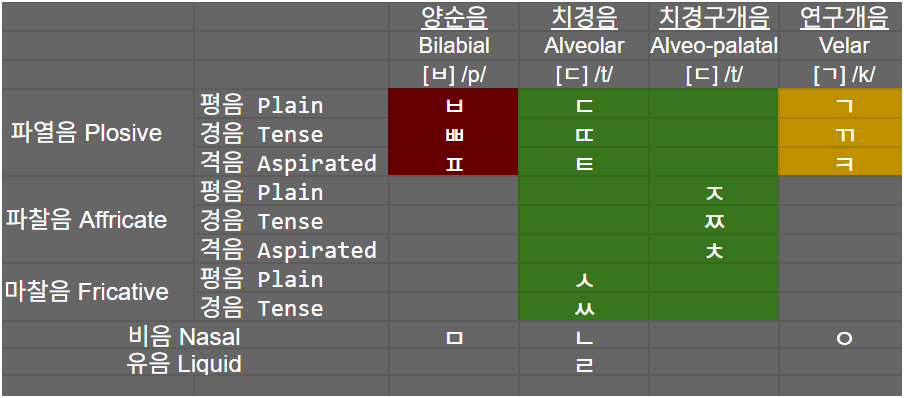
평파열음화 Batchim Sounds Become ㄱㄷㅂ Example
교과서 Material:
평파열음화. [평파열음화] to [평파여르뫄]. pyong-pa-yol-eum-hwa to pyong-pa-yo-reu-mwa.
Batchim neutralization. Batchim sound shift.
해설 Commentary:
평파열음화 [pyong-pa-yo-reu-mwa] is the sound shift of 받침[batchim].
평파열음 [pyong-pa-yo-reum] means the plain and plosive sounds in Korean.
[ㄱ], [ㅂ], and [ㄷ] sounds are 평음[pyong-eum] = plain sound and also 파열음[pa-yo-reum] = plosive sound.
By this rule,
the "K" family bachims (ㄱ, ㅋ, ㄲ) becomes a [ㄱ] sound.
The "P" family bachims (ㅂ, ㅍ) becomes a [ㅂ] sound.
The "T" family bachims (ㄷ, ㅌ, ㄸ) becomes a [ㄷ] sound.
The "S" family bachims (ㅅ, ㅆ) becomes a [ㄷ] sound.
The "J" family bachims (ㅈ, ㅊ, ㅉ) becomes a [ㄷ] sound.
Some textbooks call this rule as Batchim Neutralization or Unreleased Sound while the native Korean textbooks call it 평파열음화[pyong-pa-yo-reu-mwa].
Example of 평파열음화 Batchim Neutralization:
책. [책]. chae-k. Book.
The sound of 책 is 책[chae-k]. In this case, ㄱ받침[gi-yeok batchim] is plain sound. So, 평파열음화 = Batchim Neutralization doesn't happen.
The sound doesn't shift.
부엌. [부엌] to [부억]. bu-eok to bu-eok. Kitchen.
The sound of 부엌 is 부억[bu-eok]. In this case, ㅋ받침[ki-euk batchim] is aspirated sound. So, 평파열음화 = Batchim Neutralization happens.
The sound shifts from 부엌[bu-eok] to 부억[bu-eok]. The aspirated sound ㅋ[ki-euk] shifts to the plain sound ㄱ[gi-yeok].
곧. [곧]. god. Soon
The sound of 곧 is 곧[god]. In this case, ㄷ받침[di-geut batchim] is plain sound. So, 평파열음화 = Batchim Neutralization doesn't happen.
The sound doesn't shift.
끝. [끝] to [끋]. kkeu-t to kkeu-t. End.
The sound of 끝 is 끋[kkeu-t]. In this case, ㅌ받침[ti-eut batchim] is aspirated sound. So, 평파열음화 = Batchim Neutralization happens.
The sound shifts from 끝[kkeu-t] to 끋[kkeu-t]. The aspirated sound ㅌ[ti-eut] shifts to the plain sound ㄷ[di-geut].
옷. [옷] to [옫]. os to ot. Clothes.
The sound of 옷 is 옫[ot]. In this case, ㅅ받침[si-ot batchim] is fricative sound. So, 평파열음화 = Batchim Neutralization happens.
The sound shifts from 옷[os] to 옫[ot]. The fricative sound ㅅ[si-ot] shifts to the plosive sound ㄷ[di-geut].
곶. [곶] to [곧]. goj to got. Headland.
The sound of 곶 is 곧[got]. In this case, ㅈ받침[ji-eut batchim] is affricate sound. So, 평파열음화 = Batchim Neutralization happens.
The sound shifts from 곶[goj] to 곧[got]. The affricate sound ㅈ[ji-eut] shifts to the plosive sound ㄷ[di-geut].
꽃. [꽃] to [꼳]. kkoch to kkot. Flower
The sound of 꽃 is 곧[kkot]. In this case, ㅊ받침[chi-eut batchim] is both aspirated and affricate sound. So, 평파열음화 = Batchim Neutralization happens.
The sound shifts from 꽃[kkoch] to 곧[kkot]. The aspirated sound ㅊ[chi-eut] shifts to the plain sound ㅈ[ji-eut]. Then, in turn, the affricate sound ㅈ[ji-eut] shifts to the plosive sound ㄷ[di-geut].
집. [집]. jip. House.
The sound of 집 is 집[jip]. In this case, ㅂ받침[bi-eup batchim] is plain sound. So, 평파열음화 = Batchim Neutralization doesn't happen.
The sound doesn't shift.
숲. [숲] to [숩]. sup to sup. Forest.
The sound of 숲 is 숩[sup]. In this case, ㅍ받침[pi-eup batchim] is aspirated sound. So, 평파열음화 = Batchim Neutralization happens.
The sound shifts from 숲[sup] to 숩[sup]. The aspirated sound ㅍ[pi-eup] shifts to the plain sound ㅂ[bi-eup].
Related words of 평파열음화 Batchim Neutralization:
평음. [평음]. pyeong-eum. Plain sound.
Hanja word. 평음 (plain sound) = 평 (plain) + 음 (sound).
Among the Korean consonants, ㄱ[gi-yeok], ㄷ [di-geut], ㅂ[bi-eup], ㅅ[si-ot], and ㅈ[ji-eut] are 평음[pyeongeum].
ㅎ[hi-eut] is under discussion.
Koreans consider 평음[pyeongeum] to be a weak sound with the muscles relaxed.
Sometimes translated as Lenis for linguists.
경음. [경음]. gyeong-eum. Tense sound.
Hanja word. 경음 (hard sound) = 경 (hard) + 음 (sound).
Among the Korean consonants, ㄲ[ssang-gi-yeok], ㄸ[ssang-di-geut], ㅃ[ssang-bi-eup], ㅆ[ssang-si-ot], and ㅉ[ssang-chi-eut] are 경음[gyeongeum].
Koreans consider 경음[gyeongeum] to be a tense sound.
격음. [격음] to [겨금]. gyeok-eum to gyeo-geum. Aspirated sound.
Hanja word.격음 (Aspirated sound) = 격 (intense) + 음 (sound).
Among the Korean consonants, ㅋ[ki-euk], ㅌ[ti-eut], ㅍ[pi-eup], and ㅊ[chi-eut] are 격음 [gyeogeum].
Koreans consider 격음[gyeogeum] to be intense sounds.
It is best for learners to first remember 격음[gyeogeum] as "breath-out sounds."
Some books teach that 격음[gyeogeum] are 유기음[yuseongeum].
Sometimes translated as Fortis for linguists.
데이터 Data:
평파열음화[pyong-pa-yo-reu-mwa] Batchim neutralization DATA
소리[soli] Voice DATA
이 페이지는 한국어와 동아시아 언어를 배우기 시작하는 기본 단어들을 보여줍니다.
This page shows the basic words to start learning Korean and East Asian languages.
연구 Further study:
Yonsei Korean 1-1. Yonsei Language Institute.
Integrated Korean. Beginning 1. Young-Mee Cho. Univ of Hawaii Press.
Republic of Korea Ministry of Education (대한민국 교육부).
Japan Ministry of Education (文部科学省). 学習指導要領 生きる力. 2017.
People's Republic of China Ministry of Education (中华人民共和国教育部). Tōngyòng Guīfàn Hànzì Biǎo (通用规范汉字表). 2013.
U.S. Department of Education.
Post my Q and A