
비음화 bi-eu-mwa Nasalization Batchim becomes ㅁ ㄴ or ㅇ
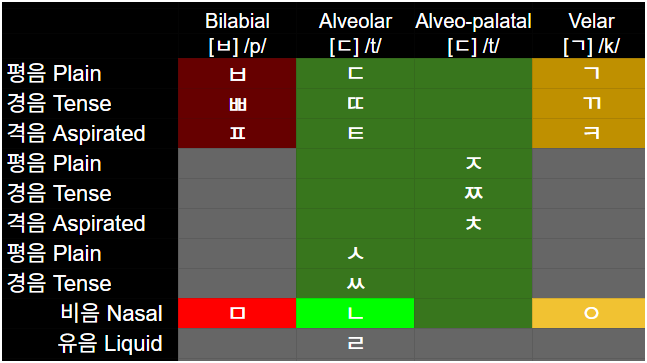
비음화 bi-eu-mwa Nasalization Batchim becomes ㅁ ㄴ or ㅇ
교과서 Material:
비음화. [비음화] to [비으뫄]. bi-eum-hwa to bi-eu-mwa .
Nasalization.
해설 Commentary:
비음화 = 비음 (nasal sounds) + 화 (to become).
비음화 [bi-eu-mwa] is one of the Korean pronunciation shifts.
In Korean, the three consonants ㅁ [mi-eum], ㄴ [ni-eun], and ㅇ [i-eung] are called 비음 [bi-eum] = Nasal Sounds.
When 비음화 [bi-eu-mwa] = Becoming Nasal Sound occurs, 받침 [batchim] changes to a nasal sound.
The P batchims (ㅂ, ㅍ) change to ㅁ [mi-eum].
The T batchims (ㄷ, ㅌ, ㅈ, ㅊ, ㅅ, ㅆ) change to ㄴ [ni-eun].
The K batchims (ㄱ, ㅋ, ㄲ) changes to ㅇ [i-eung].
비음화 [bi-eu-mwa] occurs in Korean conversations frequently, but the beginners struggle with it, especially right after learning Hanguel.
Example of 비음화 Nasalization:
십 년. [십년] to [심년]. sip-nyeon to sim-nyeon.
Ten years.
십 년 = 십 (ten) + 년 (year). 십 [sip] means Ten in numerals, and 년 [nyeon] means Year.
The correct pronunciation of 십 년 is 심년 [sim-nyeon], and 십년 [sip-nyeon] is incorrect. In this case, ㅂ받침 [bi-eup batchim] follows after ㄴ [ni-eun], so 비음화 [bi-eu-mwa] = Nasalization occurs. As a result, the ㅂ [bi-eup] in 십 changes to ㅁ [mi-eum].
겉모습. [겉모습] to [걷모습] to [건모습]. got-mo-seup to got-mo-seup to gon-mo-seup.
Appearance.
겉모습 = 겉 (outside) + 모습 (figure).
겉모습 [gon-mo-seup] means Appearance or Facade in Korean. 겉 [got] means Outside, and 모습 [mo-seup] means Figure.
The correct pronunciation of 겉모습 is 건모습 [gon-mo-seup], and 겉모습 [got-mo-seup] is incorrect. In this case, ㅌ받침 [ti-eut batchim] follows after ㅁ [mi-eum], so 비음화 [bi-eu-mwa] = Nasalization occurs. As a result, the ㅌ [ti-eut] in 겉 changes to ㄴ [ni-eun].
예문: 겉을 꾸미다.
Example: To decorate one's appearance.
작년. [작년] to [장년]. jak-nyeon to jang-nyeon.
Last year.
작년 = 작 (last) + 년 (year). 작 [jak] means Last in Hanja, and 년 [nyeon] means Year.
The correct pronunciation of 작년 is 장년 [jang-nyeon], and 작년 [jak-nyeon] is incorrect. In this case, ㄱ받침 [gi-yeok batchim] follows after ㄴ [ni-eun], so 비음화 [bi-eu-mwa] = Nasalization occurs. As a result, the ㄱ [gi-yeok] in 작 changes to ㅇ [i-eung].
박물관. [박물관] to [방물관]. bak-mul-gwan to bang-mul-gwan.
Museum.
박물관 = 박 (hundred) + 물 (thing) + 관 (hall). Hanja word. 박 [bak] means Hundred, 물 [mul] means Thing, and 관 [gwan] means Hall.
The correct pronunciation of 박물관 is 방물관 [bang-mul-gwan], and 박물관 [bak-mul-gwan] is incorrect. In this case, ㄱ받침 [gi-yeok batchim] follows after ㅁ [mi-eum], so 비음화 [bi-eu-mwa] = Nasalization occurs. As a result, the ㄱ [gi-yeok] in 박 changes to ㅇ [i-eung].
장래. [장래] to [장내]. jang-rae to jang-nae.
Future.
장래 = 장 (not yet) + 래 (to come). Hanja word. 장 [jang] means Not Yet, 래 [rae] means To Come.
The correct pronunciation of 장래 is 장내 [jang-nae], and 장래 [jang-rae] is incorrect. In this case, ㅇ받침 [i-eung batchim] follows after ㄹ [ri-eul], so 비음화 [bi-eu-mwa] = Nasalization occurs. As a result, the ㄹ [ri-eul] in 래 changes to ㄴ [ni-eun].
예문: 장래가 기대되는 청년.
例文: A young hopeful.
Related words of 비음화 Nasalization:
데이터 Data:
비음화[bi-eu-mwa] Nasalization DATA
소리[sori] Voice DATA
이 페이지는 한국어와 동아시아 언어를 배우기 시작하는 기본 단어들을 보여줍니다.
This page shows the basic words to start learning Korean and East Asian languages.
연구 Further study:
Yonsei Korean 1-1. Yonsei Language Institute.
Integrated Korean. Beginning 1. Young-Mee Cho. Univ of Hawaii Press.
Republic of Korea Ministry of Education (대한민국 교육부).
Japan Ministry of Education (文部科学省). 学習指導要領 生きる力. 2017.
People's Republic of China Ministry of Education (中华人民共和国教育部). Tōngyòng Guīfàn Hànzì Biǎo (通用规范汉字表). 2013.
U.S. Department of Education.
Post my Q and A